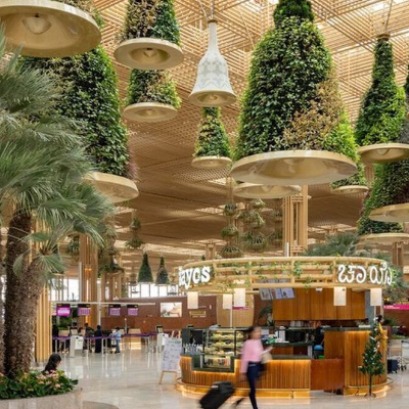
More wood | Air terminals as well-being spaces with design and natural atmosphere
In a world in which mental health, comprehensive well-being and connection with nature are increasingly urgent, wood appears as an increasingly chosen material to transform not only how we live, but also how we feel and move.
In the US, Canada, Indonesia, the Netherlands, and India, wood has already covered airports. "The advance of construction with structural wood in airports responds to three factors that are repeated in all the projects analyzed, the substantial reduction of CO2, the faster and cleaner construction, and the superior passenger experience. 1. Substantial reduction of CO2: Wood captures carbon during its growth. Replacing steel and concrete with industrialized wood reduces the embodied emissions in large buildings. scale.2. Faster and cleaner construction: Prefabrication allows large roofs and structures to be assembled with less noise, less waste and less construction time.3. Superior passenger experience: Biophilia once again takes center stage: interiors with visible wood, integrated gardens, green roofs and natural light reduce stress and improve visual and thermal comfort.Mass timber: trend-setting examplesIn different regions of the world, new airports and expansions are prioritizing sustainable projects with wood and vegetation:• Portland International Airport (United States): one of the largest mass timber projects in the country. Its new undulating wooden roof creates an “inner forest” feeling, with live trees and gardens inside the terminal.• Fort McMurray International (Canada): pioneer in the intensive use of CLT and glulam in a complete air terminal.• Banyuwangi International (Indonesia): bioclimatic design with green roof, natural ventilation and renewable materials.• Rotterdam The Hague (Netherlands): It incorporates extensive vegetated roofs, which improve thermal insulation and reduce the heat island effect.• Kempegowda International Airport (India): one of the most ambitious cases of a biophilic airport, with green walls, hanging gardens and wooded interior areas.Although the phenomenon is global, it has a key peculiarity: it is recent and growing rapidly, driven by climate regulations, carbon certifications, energy efficiency and the need to generate more human spaces for passengers and workers.What does this trend mean for ArgentinaFor CADAMDA, The expansion of these initiatives opens up a huge opportunity: • position the country as a supplier of certified industrial wood; • promote public and private infrastructure projects with a lower carbon footprint; logical in the global sustainability agenda. From CADAMDA they point out that the global trend confirms something that research and professional practice have been demonstrating for years: wood is not only a material for housing; it is a material for large-scale infrastructure, capable of reducing emissions, improving comfort and accelerating construction times. The world is moving towards more sustainable buildings, and wood is leading that path, even in airports, one of the most demanding sectors in terms of engineering and operation, the Chamber concludes.
IT MAY INTEREST YOU
 Nation reinforces prevention and training against forest fires
The director of the Federal Emergency Agency (AFE), Santiago Hardie, referred to the support that the Nation provides in fighting fires. He argued that the majority of igneous sources respond to human interventions and that, therefore, social awareness is a central tool to reduce environmental, material and human damage.
 Color the streets pink and white in spring: which is the most beautiful tree in the world and why, according to AI
Its delicate branches, the soft tones of its petals and the harmonious shape of the tree make it an almost poetic image.
 The DNA of forests: they discover what makes a tree resist drought
An international team, with the participation of INTA and Conicet, discovered that genetics can be decisive for trees to better resist droughts