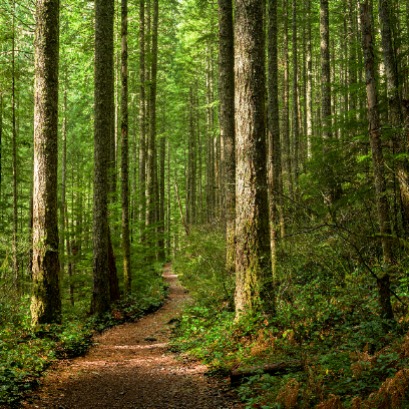
CSIC scientists show that Europes forests lose their ability to absorb carbon for years
The forests of Europe have lost the ability to absorb carbon in recent years due to different factors that are analyzed and quantified in a recent CSIC study, Higher Council for Scientific Research.
The intensification of wood felling, the decrease in repopulations and extreme episodes of heat and drought, among the responsible factors. Forests are allied in the fight against climate change thanks to their ability to absorb CO? of the atmosphere and keep it kidnapped in the form of carbon in the trunk, the leaves, the roots or in the soil. They currently cover about 40% of the territory of the European union Between 1990 and 2022, they have absorbed around 10% of emissions derived from human activity. Even so, a recent article published in the Nature magazine, led by Mirco Migliavacca, a researcher at the Joint Research Center, and that has had the participation of CREAF and CSIC, warns that its ability to kidnap carbon is in decline. According to the EU Lulucf inventory (which calculates the carbon sinks of the forest ground, wet areas, wet areas, and agricultural areas Among others), the forest carbon deposit in Europe went from 457 million tons of equivalent absorbed every year between 2010 and 2014 to 332 million tons of CO? equivalent absorbed every year between 2020-2022. That is, a reduction of almost a third in just a decade. This ends at risk the climatic objectives of the European Union that establishes that the EU has to be climatic neutrally in 2050. Within this roadmap, the revised regulations on the Lulucf sector set for 2030 the goal of absorbing 310 million tons of equivalent. If we take into account the decline lived in 10 years, it seems that this will not be possible. Factors of the declines factors behind this decline are several and often interconnected. The study identifies as main responsible the intensification of wood felling, linked to a growing demand for wood consumption both at European and global scale; The increase in natural disturbances such as fires, storms and pests, which are often followed by premature talas to remove dead or burned wood; to the fact that forests no longer expand at a pace as accelerated as a few years ago and there are no longer as many repopulations; to the aging of forests, which reduce their capacity for growth and carbon absorption; and to the extreme episodes of heat and drought, which decrease the photosynthesis and the productivity of the trees. These impacts may have persistent effects for years, weakening forests and aggravate forest mortality and carbon ability losses. Missing to urgently focus on the focus implies a balance between productive activities, such as logging, and the conservation of natural habitats. The study, then, suggests science -based management models that combine forests with different ages and degrees of protection, alternating areas for sustainable production with other reserved for strict conservation. This diversification helps protect biodiversity and maintain carbon stored in different forest compartments, such as living wood, dead wood and soil. Thus, this solution will only be valid in very determined places and with more favorable climatic conditions.
IT MAY INTEREST YOU
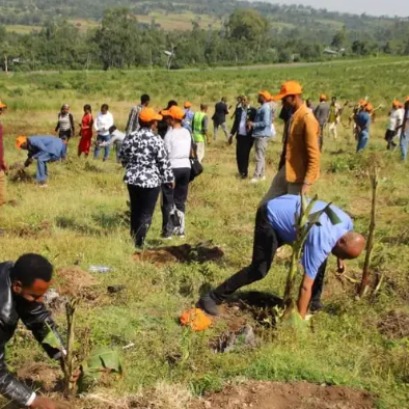 The country that planted 350 million trees in one day and caused great consequences
Discover the country that planted 350 million trees in one day and caused great consequences Climate change and deforestation have caused great ecological damage in many places. For this reason, a country planted 350 million trees in one day and thus obtained a world record, although it is estimated that in 2025, it will plant twice as many.
 More wood | Air terminals as well-being spaces with design and natural atmosphere
In a world in which mental health, comprehensive well-being and connection with nature are increasingly urgent, wood appears as an increasingly chosen material to transform not only how we live, but also how we feel and move.
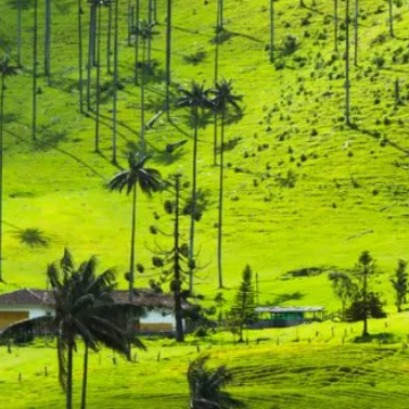 The tallest palm tree in the world is in South America: it is the height of a 20-story building
The worlds tallest palm tree stands deep in South America, a giant that challenges the limits of plant life Deep in South America, between the fog and the mountains, hides a giant tree that few know about. Majestic and silent, challenging the world on what plant life can achieve.