Sustainable Forests: "Trees tell us the truth about the climate crisis"
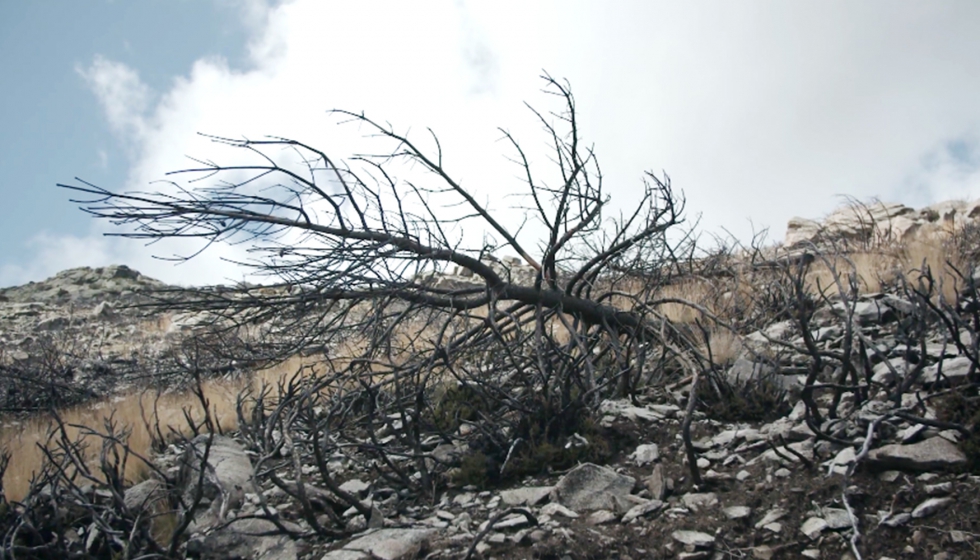
Climate change is today more than ever a tangible reality. CO2 emissions from industrial activity and citizens have grown incessantly for years. To alleviate its effects on ecosystems caused by deforestation caused by fires, Sustainable Forests has started a project to raise awareness in society and to reforest a burned forest belonging to the Iruelas Valley Natural Reserve.
More than 140 hectares of this enclave located in the southern part of Ávila were devastated at the end of the summer of 2019 due to one of the most voracious fires of the season. However, the centuries-old scots pines and oaks that once inhabited the valley have come to life with one mission: let the truth be known.
Thanks to dendrochronology, a science that is capable of recovering the information recorded in the tree rings, the analysis of several specimens that died in a fire in 2019 has been carried out, carried out by the University Institute of Sustainable Forest Management ( iuFOR) belonging to the University of Valladolid.
In this study, specific data on these trees have been known, such as their age, the climatic conditions in which they developed, including plagues, floods, fires and other events that could have affected them, but very relevant conclusions have also been drawn that show the climate crisis that we are suffering, such as that there is a high negative correlation between tree growth and annual average and maximum temperatures or that the natural regeneration of Mediterranean forests is severely affected by climate change.
Combining these real data with the imagination of Nagore Suárez, a young talent in Spanish literature and winner of the Twitter Thread Fair, Bosques Sostenibles has created La Verdad de los Arboles, a campaign that consists of a series of podcasts that tell the story in first person of some of these specimens that lived and died in the Iruelas Valley and that will serve to launch a message of awareness to society.
Trees warn us of the danger posed by the lack of initiatives that protect us from climate change.
One of the methods that has been shown to have the greatest impact to stop the degradation of the planet is the replanting of large areas of land. Due to the extensions that these new green spaces reach, they are capable of purifying a high volume of CO2. It is at this point where this campaign takes on a special importance for society.
“The Truth of the Trees is intended to be a tribute to our front line battle against the climate crisis. A tree gets to eliminate from the atmosphere and synthesize in its bark about 180 kg of CO2 in 40 years, an amount equivalent to the emissions generated by a journey of about 1,800 km by a car "That is why it is so important to take care of our forests", explains Elena Álvarez, responsible for Sustainable Forests.
During its more than ten years of experience, Sustainable Forests has carried out numerous reforestation projects in different Spanish forests, which has made it part of the group of companies accredited by the Ministry for the Ecological Transition and the Demographic Challenge through the Carbon Footprint Registry, compensation and carbon dioxide absorption projects.

IT MAY INTEREST YOU
 The DNA of forests: they discover what makes a tree resist drought
An international team, with the participation of INTA and Conicet, discovered that genetics can be decisive for trees to better resist droughts
 The South American country that changes construction thanks to an ancient, mega-resistant material: more than steel
This material that grows in South America creates the most resistant constructions and radically changes the world of architecture One particular building material has been used for millennia by various cultures in South America. This is due to its structural resistance that allows the creation of homes, bridges and shelters. Its archaeological presence shows that it was one of the most valued construction resources in seismic and humid areas.
 The city in South America that breathes thanks to a thousand olive trees planted in the 17th century
In the heart of South America there is a city that, among the noise and concrete, still breathes thanks to an olive forest