Goodbye to the crystal: the revolution of the transparent wood of a Swedish scientist (that you will want to put in your windows)
For years his project was a source of laughter, until the result has been seen. It saves energy, it is biodegradable, it does not generate a magnifying glass effect inside the house, it preserves privacy ... Its inventor calculates that in five years it will be used in homes
Who has visited the Glass House, or House of Glass, of Philip Johnson in Connecticut (USA) affirms that it has the sensation of being walking through the field with a heavy roof over it. The architect built this house in which he lived until his death with the conviction of intervening only in nature using glass walls. This option of transparent walls today can be closer to domestic use.
The Swedish scientist Lars Berglund, professor of the Wallenberg Wood Science Center of the Royal Institute of Technology of Stockholm (KTH), has created the first transparent and biodegradable wood that can become the constructive element of the future. For this he eliminated the lignin from the balsa wood, the component that gives rigidity to this material and makes it opaque, and the resulting substrate impregnated it in a transparent polymer. Thus he obtained a material similar to wood in rigidity, which allows light to pass through and, in addition, is capable of absorbing heat.
"Wood is by far the most used biological material in buildings, it is also very attractive because it comes from renewable sources and offers excellent mechanical properties, including strength, toughness, low density and low thermal conductivity." clarifies the Swedish scientist.
One of the direct effects of using this type of transparent wood is aimed at its ability to absorb heat, causing the opposite effect to that felt in the stifling interior of a glass building exposed to the sun. With its use, the construction sector would save costs for a correct air conditioning and would help the development of solar energy. Transparent wood is a good material to be used in large areas of solar panels, it is low cost, easy to reach and renewable.
But what the scientific community and the architects wonder is whether this material could also be used for windows and facades. When the lignin is extracted, the wood becomes white, but not naturally transparent. That is, it would be perfect to create walls that let in light but kept the privacy of the interior.
Diego Barajas, from the Spanish studioHusos Arquitectos, reflects on this transparent wood, also, from a social perspective: "It would be interesting to ask ourselves how it could serve to build new microclimates not only in thermal and environmental terms, but also socially. construction of spaces that are thermally protected and at the same time more fluid and visually less fragmented, with the passage of light, shadows or new lighting nuances would be generated, perhaps leading to new visual relationships between activities in the city that tend to remain separate ".
Lars Berglund, who began with these investigations in 2016, is currently working on the industrial production of this new material, with other types of wood, improving its transparency. A few days ago he commented, in front of the American Chemical Society, that "the only part of this material that is not biodegradable is acrylic, but we hope to replace it with another bio-based polymer." In five years, Berglund foresees the first domestic applications in interior design.

IT MAY INTEREST YOU
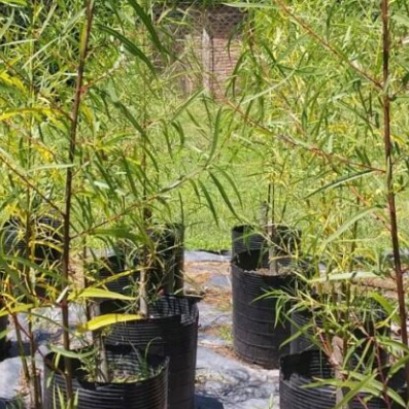 INTA Delta begins propagation of seven Creole willow clones for ecological restoration in Paraná
As a result of the rescue, domestication and registration work carried out by Teresa Cerrillo, a leading researcher in Salix Genetic Improvement, within the framework of the National Genetic and Forest Resources Programs of INTA, the multiplication and propagation of seven clones of Creole willow (Salix humboldtiana) began recently registered in the National Seed Institute (INASE) by INTA Delta del Paraná.
 Reforestation advances in the Historic Sanctuary of Machu Picchu with new restored hectares
The plan includes the planting of a thousand new trees in the sanctuary, in response to the damage caused by forest fires and environmental threats, with the support of local authorities and representatives of the tourism sector.
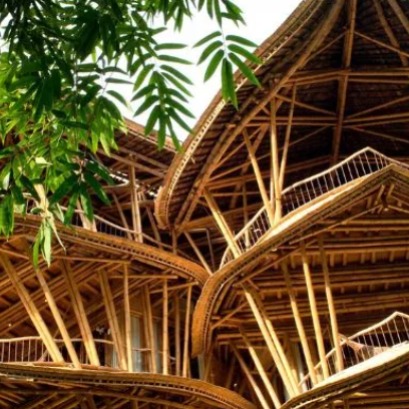 The South American country that changes construction thanks to an ancient, mega-resistant material: more than steel
This material that grows in South America creates the most resistant constructions and radically changes the world of architecture One particular building material has been used for millennia by various cultures in South America. This is due to its structural resistance that allows the creation of homes, bridges and shelters. Its archaeological presence shows that it was one of the most valued construction resources in seismic and humid areas.